
Hydraulic cylinders are essential components in modern hydraulic systems, providing linear force and motion for industrial, construction, and mobile equipment. Understanding the different cylinder types helps engineers and buyers choose the right solution for their machines and operating conditions.
This guide explains common hydraulic cylinder types, their working principles, applications, and selection tips.
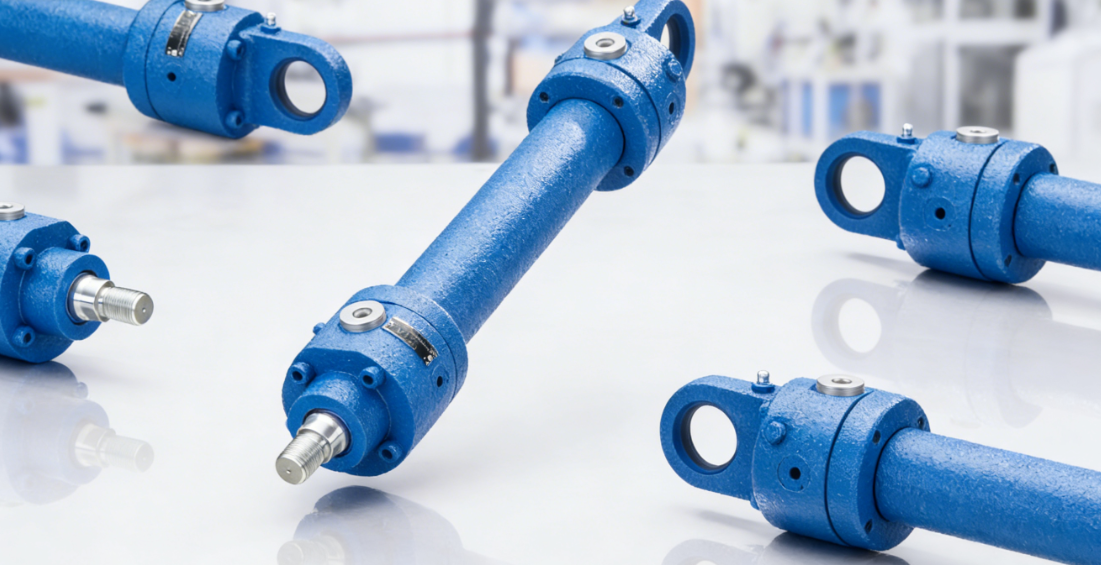
Hydraulic cylinders convert hydraulic pressure into mechanical movement to push or pull loads. They are widely used in construction equipment, agricultural machinery, industrial automation, and material handling systems.
Different designs are used depending on stroke length, mounting requirements, load capacity, and space limitations.
A single acting hydraulic cylinder uses hydraulic pressure to move in one direction, while the return stroke is achieved by gravity, springs, or external force.
Single acting cylinders are suitable for systems where only one powered direction is required.
A double acting hydraulic cylinder uses hydraulic pressure to extend and retract the piston rod, providing controlled motion in both directions.
When choosing between single acting or double acting cylinders, automation and motion control requirements are key factors.
Telescopic hydraulic cylinders consist of multiple nested stages that extend sequentially, providing a long stroke in a compact retracted length.
A telescopic cylinder is ideal for applications with limited installation space but large stroke requirements.
Tie rod hydraulic cylinders use threaded steel rods to hold the cylinder assembly together.
Tie rod cylinders are widely used due to their serviceability and standardized design.
A rod hydraulic cylinder with welded construction has end caps welded directly to the cylinder barrel.
Welded cylinders are preferred where compact size and high pressure resistance are required.
In addition to the main categories, common types of hydraulic cylinders include:
Provide different force during extension and retraction due to rod area differences.
Use a rod without a piston, suitable for pushing loads.
Include sensors for precise motion control in automated systems.
These cylinders including advanced designs are used in automation and precision equipment.
The cylinder barrel is typically made from high-strength steel to withstand pressure and wear.
Material selection affects durability, sealing performance, and operating life.
When selecting a hydraulic cylinder, consider:
Choosing the right cylinder ensures reliable performance for each specific application.
Hydraulic cylinders are used in many industries:
Excavators, cranes, bulldozers, and loaders use various cylinder types for lifting and movement.
Tractors, harvesters, and plows use hydraulic cylinders for steering and lifting.
Forklifts and conveyors use cylinders for positioning and lifting loads.
Presses, automation lines, and machine tools use cylinders for controlled motion.
The main types include single acting, double acting, telescopic, tie rod, and welded rod hydraulic cylinders.
Single acting cylinders use pressure in one direction, while double acting cylinders use pressure to extend and retract the piston rod.
Telescopic hydraulic cylinders are commonly used in dump trucks and tipping applications where a long stroke is required in a compact design.
A tie rod hydraulic cylinder uses threaded steel rods to secure the assembly, making it easier to maintain and repair.
The cylinder barrel is the main housing that contains the piston and hydraulic fluid and is usually made from high-strength steel.
Consider stroke length, load, pressure, mounting style, and whether single acting or double acting operation is required for your application.
Hydraulic cylinders come in many designs to meet different operational needs. Understanding cylinder types, telescopic designs, tie rod construction, and single or double acting operation helps buyers select the right solution for industrial and mobile hydraulic systems.